 Tokely
Research scope: This study compares official AI API list prices as of October 5, 2026. Model release dates are used to compare pricing across model generations, not to reconstruct historical price changes.
THE SHORT ANSWER
At current official prices, the newest top-tier model of 66 we compared lists output tokens at 6.25x the price of an April 2025 flagship: $50 versus $8 per million. Workhorse models from different generations sit at the same $10, and the cheapest models from 2024 and 2026 cost about the same, $0.40 to $0.60. On most current models, cached input is 90 to 98% cheaper than fresh input.
What did we measure?
Our dataset tracks 66 production language models released between April 2024 and September 2026 across eight commercial model developers. OpenAI accounts for 38 models, Anthropic accounts for 12, Qwen provides five, Google provides five, Moonshot has two, DeepSeek has two, MiniMax has one, and xAI has one.
For each model, we gathered the official list price per 1 million input tokens, 1 million output tokens, and 1 million cached-input tokens, verified on October 5, 2026. We also recorded each model's official release date, which we use only to group models by generation.
The findings are organized around four charts: flagship pricing, tier distribution, caching discounts and output-to-input ratios. All figures are list prices in US dollars per 1 million tokens. The full dataset is available as a CSV file so you can check every number.
Finding 1: The flagship premium
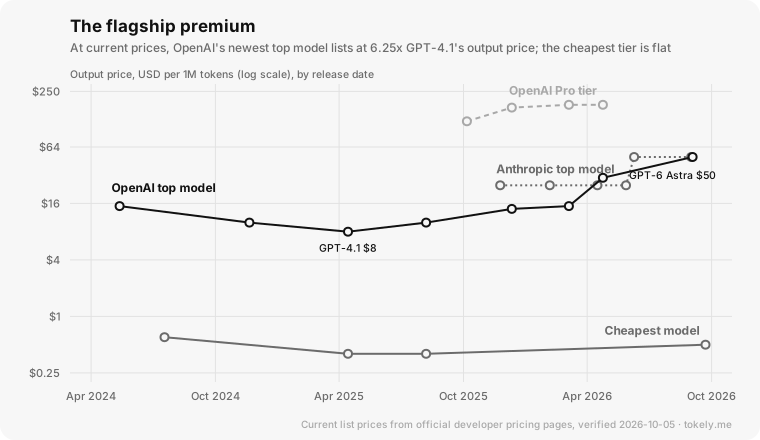
We call the main pattern the flagship premium: at today's prices, each newer top-tier model lists far above the previous generation's flagship, while workhorse and budget models of different generations cost about the same.
OpenAI's top general models show it across eight generations. At current list prices, the May 2024 GPT-4o snapshot costs $15 per 1 million output tokens and the November 2024 snapshot $10. GPT-4.1 (April 2025) is the cheapest flagship at $8. Each later generation lists higher: GPT-5 (August 2025) at $10, GPT-5.2 (December 2025) at $14 and GPT-5.4 (March 2026) at $15.
The gap widens in the two newest generations. GPT-5.5 (April 2026) lists at $30 per 1 million output tokens and GPT-6 Astra (September 2026) at $50. Today GPT-6 Astra's output price is 6.25x that of GPT-4.1, released 17 months earlier.
Above the flagships sits OpenAI's Pro tier. GPT-5 Pro (October 2025) lists at $120 per 1 million output tokens, GPT-5.2 Pro at $168, and GPT-5.4 Pro and GPT-5.5 Pro at $180, the highest output price in the dataset.
Anthropic reaches the same ceiling differently. Every Opus generation from Claude Opus 4.5 (November 2025) to Claude Opus 5 (July 2026) lists at $25 per 1 million output tokens. Instead of pricing Opus higher, Anthropic added a tier above it: Claude Fable 5 (June 2026) and Claude Fable 5.1 (September 2026) list at $50.
Finding 2: The workhorse tier sits at $10
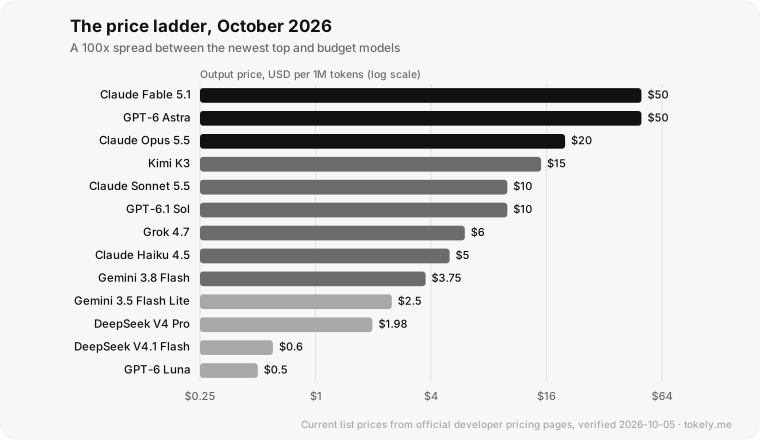
While the newest top-tier models list at $50, the workhorse tier sits at $10 per 1 million output tokens across generations. GPT-6.1 Sol (September 2026) lists at $2 input and $10 output, the same output price as GPT-5 (August 2025).
Anthropic's newer mid-tier models list lower than older ones. Claude Sonnet 4.6 (February 2026) lists at $15 per 1 million output tokens, while Sonnet 5 (June 2026) and Sonnet 5.5 (September 2026) list at $10. Claude Opus 5.5 (September 2026) lists at $4 input and $20 output, below every earlier Opus at $5 and $25.
Developers now ship explicit three-tier families. OpenAI's GPT-6 family lists Astra at $50, Sol at $10 and Luna at $0.50 per 1 million output tokens. Across all developers, the newest models span a 100x output price range: Claude Fable 5.1 and GPT-6 Astra at $50 at the top, GPT-6 Luna at $0.50 at the bottom.
In between, Kimi K3 lists at $15 per 1 million output tokens, Grok 4.7 at $6, Claude Haiku 4.5 at $5, Gemini 3.8 Flash at $3.75, Gemini 3.5 Flash Lite at $2.50, DeepSeek V4 Pro at $1.98 and DeepSeek V4.1 Flash at $0.60.
Finding 3: Budget models from 2024 and 2026 cost the same
The cheapest output prices are nearly identical across generations. GPT-4o mini (July 2024) lists at $0.60 per 1 million output tokens, GPT-4.1 nano (April 2025) and GPT-5 nano (August 2025) at $0.40, and the September 2026 budget models GPT-6 Luna and DeepSeek V4.1 Flash at $0.50 and $0.60.
Input prices at the bottom sit in a similar band. GPT-5 nano lists input at $0.05 per 1 million tokens, GPT-6 Luna at $0.10 and DeepSeek V4.1 Flash at $0.15. Across generations, the cheapest input price stays between $0.05 and $0.15.
This study compares list prices, not capability. A budget model from September 2026 may handle harder tasks per token than one from July 2024; we did not test that.
Finding 4: Cached input costs 10 to 50x less on most current models
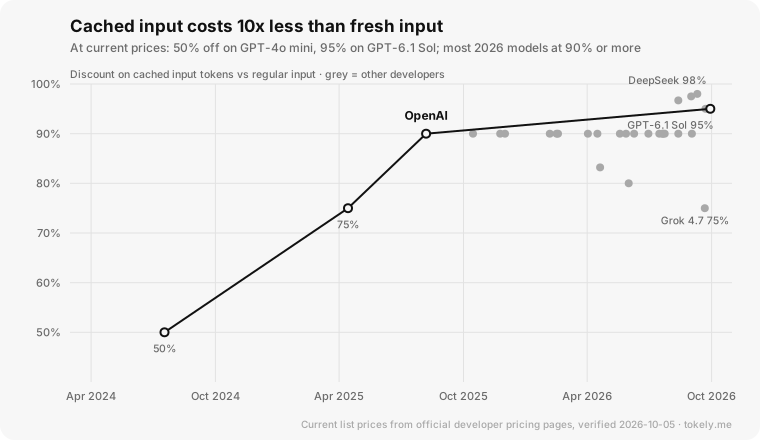
Cache discounts differ most between generations. At current prices, OpenAI's cached-input discount is 50% on GPT-4o mini (2024), 75% on GPT-4.1 (April 2025), 90% on GPT-5 (August 2025) and 95% on GPT-6.1 Sol (September 2026). A 95% discount makes cached input 20x cheaper than fresh input.
Anthropic lists a 90% cached-input discount on Claude Opus 4.5 through Opus 5, 95% on Claude Opus 5.5 and Claude Sonnet 5.5, and 97.5% on Claude Fable 5.1. DeepSeek V4.1 Flash lists 98%: $0.003 cached versus $0.15 fresh input.
A few developers discount less: Grok 4.7 lists 75% off, MiniMax M3 80% and Kimi K2.6 83%. On most 2026 models, though, cached input costs 10x to 50x less than fresh input.
The difference is easy to see on a long context. On GPT-6.1 Sol, a 100,000-token context costs $0.20 as fresh input at $2 per 1 million tokens. Cached, the same context costs $0.01.
Finding 5: Newer models price output at 5x input
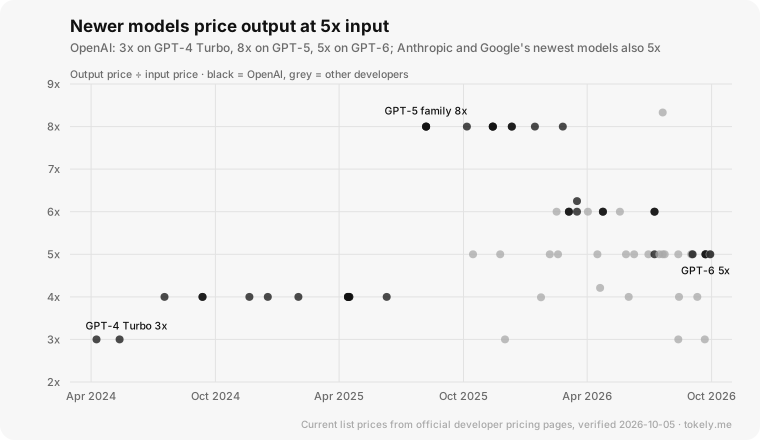
The output-to-input price ratio differs by generation. GPT-4 Turbo (April 2024) lists output at 3x input. OpenAI models from GPT-4o to o4-mini use 4x, the GPT-5 family (August 2025 to February 2026) 8x, GPT-5.4 and GPT-5.5 6x, and the GPT-6 family 5x.
Other developers' current models use the same multiple. Every Anthropic model in our dataset lists output at 5x input, and so do Gemini 3.6, 3.7 and 3.8 Flash. DeepSeek uses 3x to 4x and Grok 4.7 3x.
Because output tokens cost three to eight times more than input tokens, output volume usually decides the bill. Workloads that generate long text, code or multi-step reasoning are the most sensitive to the output price.
What should teams do with this?
Route by tier. With a 100x spread between the newest top and budget models, send routine tasks like data extraction, classification, and short conversational turns to models in the $0.50 to $10 output price range. Reserve $50 models like GPT-6 Astra or Claude Fable 5.1 for the tasks that need them.
Design prompts for caching. Put system instructions, schemas and reference documents at the front of every request so they stay identical across calls. Cached input is 90% to 98% cheaper than fresh input on most current models, so every stable token at the front of a prompt pays off.
Forecast output, not input. Output tokens cost five times as much as fresh input tokens and up to two hundred times as much as cached input tokens. Tokely gives you one API key and one balance across all of these tiers, with routing modes and automatic fallback; compare rates on Tokely pricing and estimate a workload with the cost calculator.
Methodology and limitations
Prices in this study are official list prices verified on October 5, 2026. They are a snapshot, not a price history: release dates only group models by generation. Some models were repriced after release, such as OpenAI lowering o3 to $2 per 1 million input tokens and $8 per 1 million output tokens in June 2025, so a model's current price can differ from its launch price. Release dates come from official release notes, or the dated model identifier where no notes exist; the CSV records the source for each row.
The sample covers models tracked in Tokely's catalog, which weights it toward OpenAI with 38 of the 66 entries. We excluded realtime and audio models, batch and priority tiers, long-context surcharges and taxes. All prices are in US dollars per 1 million tokens.
Data and citation
The full dataset of 66 models includes developer names, model identifiers, release dates, input rates, output rates, cached input rates, and source verification URLs, and is available for download at ai-api-price-study-2026.csv. Cite as: Tokely (2026). Are AI APIs Getting Cheaper? Official Prices of 66 Models, 2024-2026. https://tokely.me/blog/ai-api-price-trends-2026