 Tokely
Research scope: This study covers text-generation models listed on the official deprecation pages of OpenAI, Anthropic and Google, read on November 24, 2026: 64 models with a shutdown date on or before that day and 19 with a later announced date. Lifespan is the shutdown date minus the release date. Models with no announced shutdown date are not counted, so the medians describe retired models, not the expected life of models that are active today.
THE SHORT ANSWER
The median retired text model at OpenAI, Anthropic and Google was shut down 403 days after release. We call it the 13-Month Model. Across 64 retired models, 24 lived less than a year. Google preview models had a median life of 187 days and a median notice of 28 days, while OpenAI gave its generally available snapshots a median of 184 days' notice and Anthropic gave 69.
What did we measure?
On November 24, 2026 we read the official deprecation pages of OpenAI, Anthropic and Google and kept text-generation models. That gave 83 rows: 64 models already retired and 19 with a shutdown date still ahead. The retired set holds 39 OpenAI models, 15 from Google and 10 from Anthropic.
Lifespan is the shutdown date minus the release date. Notice period is the shutdown date minus the date the shutdown was announced; for Google, announcement dates come from the Gemini API release notes. We split retired models into generally available (GA) models (31), previews (20) and specialized variants such as chat-latest aliases, Codex and deep-research models (13, all OpenAI).
Finding 1: The 13-Month Model
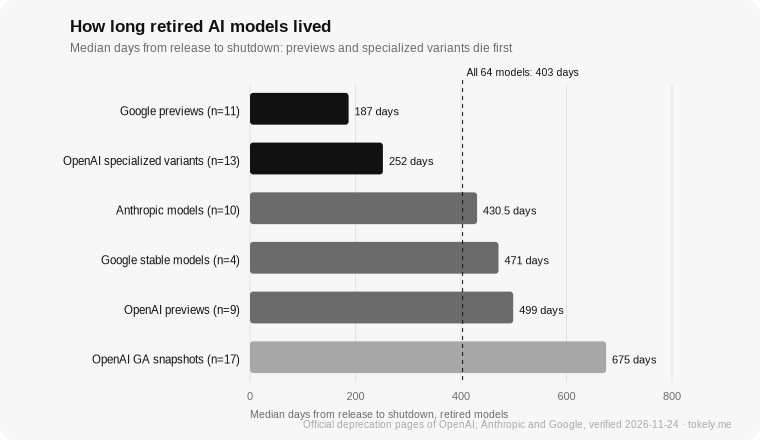
The 13-Month Model is the median of our dataset: 403 days, about 13 months, from release to shutdown. Of the 64 retired models, 24 (37.5%) lived less than a year and 54 (84%) lived less than two years. By type, GA models had a median of 555 days, previews 300.5 and specialized variants 252.
The spread between developers is wide. Google previews had a median of 187 days (11 models), OpenAI specialized variants 252 (13), Anthropic models 430.5 (10), Google stable models 471 (4), OpenAI previews 499 (9) and OpenAI GA snapshots 675 (17). The longest-lived model is gpt-4-0613: 1,228 days, from June 13, 2023 to October 23, 2026.
Shutdown dates also cluster: 45 of the 64 fall in 2026, 14 in 2025 and 5 in 2024. Two OpenAI dates, July 23 and October 23, 2026, account for 22 of the 64, and all 22 shutdowns were announced on the same day, April 22, 2026.
Finding 2: Previews and aliases live shortest
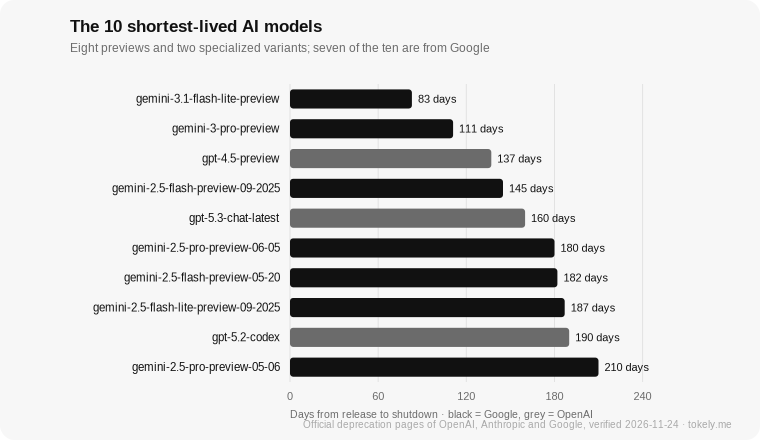
The ten shortest lifespans belong to eight previews and two specialized variants, and seven of the ten are Google's. Gemini 3.1 Flash-Lite Preview ran from March 3 to May 25, 2026: 83 days. Gemini 3 Pro Preview ran from November 18, 2025 to March 9, 2026: 111 days.
OpenAI's shortest is GPT-4.5 Preview. It was released on February 27, 2025, its deprecation was announced on April 14, 46 days later, and it was shut down on July 14, 2025 after 137 days. The gpt-5.3-chat-latest alias lasted 160 days (March 3 to August 10, 2026) and gpt-5.2-codex 190 days (January 14 to July 23, 2026). A preview label does not always mean a short life: gpt-4-1106-preview lived 1,082 days.
Finding 3: Notice runs from 11 days to six months
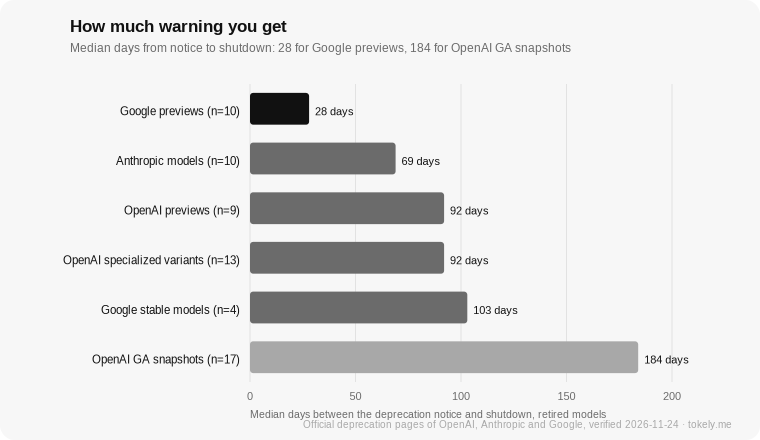
Median notice was 184 days for OpenAI GA snapshots, 103 for Google stable models, 92 for OpenAI previews, 92 for OpenAI specialized variants, 69 for Anthropic models and 28 for Google previews. OpenAI's policy promises at least 6 months for GA models and at least 3 months for specialized variants, and says previews "may be retired with much shorter notice, such as 2 weeks". Anthropic promises at least 60 days, and its retired models got 60 to 189.
Google's models page says previews are deprecated "with at least 2 weeks notice". Ten retired Google previews with a dated shutdown announcement got 11 to 35 days. The shortest was Gemini 3 Pro Preview: announced on February 26, 2026 and shut down on March 9, 11 days later, with the name then pointing to gemini-3.1-pro-preview.
Stable models can move quickly too. On September 18, 2026 Google's release notes said the Gemini 2.5 models "are not deprecated and will continue to be served until further notice through the API". On November 2, 45 days later, they listed gemini-2.5-pro and gemini-2.5-flash as deprecated, effective December 1, 2026: 29 days' notice. Gemini 2.5 Flash-Lite is not deprecated.
Finding 4: Anthropic's one-year floor is exact
All 16 Claude models marked active on Anthropic's status table carry a "not sooner than" retirement date exactly one year after their launch in the release notes. Claude Opus 4.6, for example, launched on February 5, 2026 and will retire not sooner than February 5, 2027.
Claude Opus 4.5 shows how the floor works in practice. It launched on November 24, 2025. On November 23, 2026, one day before its first anniversary, Anthropic announced retirement on January 22, 2027: 60 days' notice and a life of 424 days. The floor is a minimum, not a schedule: Claude Haiku 4.5's date, October 15, 2026, has passed and the model is still listed as active.
Retired Claude models lived 360 to 774 days. Claude Sonnet 3.7 was the shortest at 360 days, and Claude Opus 4.1 lived exactly 365.
Finding 5: 15 shutdowns before January 23, 2027
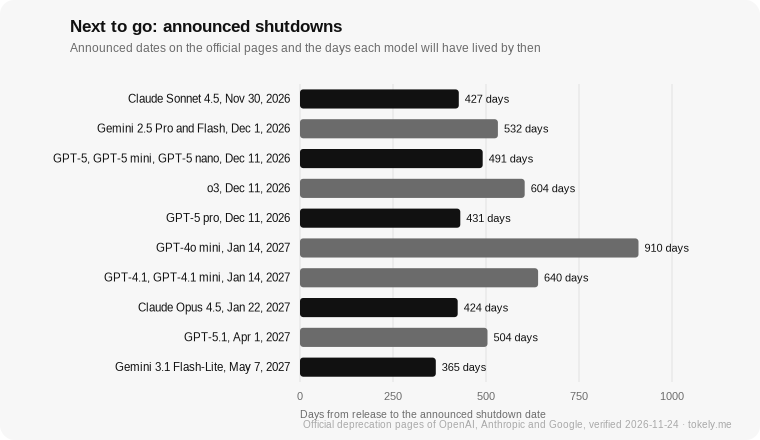
Of the 19 scheduled models, 15 have dates from November 30, 2026 to January 22, 2027. Claude Sonnet 4.5 goes first on November 30 after 427 days, followed by Gemini 2.5 Pro and 2.5 Flash on December 1 after 532 days. GPT-5, GPT-5 mini and GPT-5 nano reach December 11 at 491 days, along with GPT-5 pro (431), o3 (604) and o3-pro (549).
Two GPT-4o snapshots, GPT-4o mini, GPT-4.1 and GPT-4.1 mini share January 14, 2027; GPT-4o mini will have lived 910 days and GPT-4.1 640. Claude Opus 4.5 follows on January 22. GPT-5.1, GPT-5.3 Codex and GPT-5.4 nano are scheduled for April 1, 2027 at 504, 401 and 380 days, and Gemini 3.1 Flash-Lite lists May 7, 2027 as its earliest possible date, 365 days after release.
Not every end date returns an error. From December 1, API requests to gemini-2.5-pro will route to gemini-3.8-flash and requests to gemini-2.5-flash to gemini-3.5-flash-lite, billed at the new model's rates. Requests to gemini-3.5-flash already route to gemini-3.6-flash, and gemini-3.7-flash (released August 13, 2026) routes to gemini-3.8-flash (released September 2, 2026). The model name keeps working; the model behind it is different.
What should teams do with this?
Plan for a model life of 12 to 18 months and put a yearly migration in the budget. Treat previews, chat-latest aliases and Codex variants as short-lived: in this data, Google previews had a median of 187 days and OpenAI specialized variants 252.
Watch the signals. OpenAI's List models endpoint has an optional shutdown_date field, Anthropic notifies customers with active deployments, and Google announces deprecations on its release notes page. Plan on the policy minimums: 60 days at Anthropic, 6 months for OpenAI GA models, 2 weeks for Google previews. For models that route, rerun tests on the new model before the routing date, because Google's release notes list breaking API changes for the Gemini 2.5 move.
With Tokely you call OpenAI, Anthropic, Google and other models through one API key, so moving to a replacement is a change of the model name in one place: Tokely models.
Methodology and limitations
All pages were verified on November 24, 2026. Each CSV row has a release source and a deprecation source URL, and rows with a notice date have an announcement source. A model counts as retired when its listed shutdown date is on or before November 24, 2026. Release dates come from the official changelog, release notes, launch announcement or the Gemini deprecations page where they exist, otherwise from the snapshot date in the model ID, which can be days before public availability.
Three date choices matter. For gemini-2.5-pro-preview-03-25 the deprecations page lists March 3, 2025 and the release notes April 4, 2025; we use the release notes. Where OpenAI lists more than one notice for a model, we use the notice date in the row with the final shutdown date. Google's dates are the earliest possible dates on its page, and some Google previews were redirected to newer versions before the endpoint's shutdown date, so the model behind the name changed earlier than our number shows.
Excluded are embedding, image, video, audio, realtime, robotics, moderation and fine-tuning models, managed agents, and models without a sourced release date, such as Claude 1, Claude 2, gpt-3.5-turbo-instruct and the cyber models. The model gemini-2.5-computer-use-preview-10-2025 has no dated shutdown announcement in the release notes and is left out of the notice medians. Aliases and snapshots count as separate rows as the pages list them; removing four duplicate names leaves 60 models and the same 403-day median.
Medians cover retired models only. Adding the 19 scheduled models moves the median to 461 days, and models with no announced date are not counted at all. Anthropic's dates apply to Anthropic-operated platforms; Amazon Bedrock and Google-managed Claude set their own schedules.
Data and citation
The dataset is free to download: 83 model rows with release date, announcement date, shutdown date, lifespan, notice days and source URLs: ai-model-lifespans-2026.csv.
Cite as: Tokely (2026). How Long Do AI Models Live? Release-to-Shutdown Days for 64 OpenAI, Anthropic and Google Models. https://tokely.me/blog/ai-model-lifespans-2026