 Tokely
Research scope: This study compares official API list prices verified October 29, 2026. DeepSeek is the only price history: its August 1 (archived page), August 16 and September 10, 2026 price tables. For the other developers, generations are compared at the prices listed on October 29, 2026; earlier versions are not historical launch prices.
THE SHORT ANSWER
Partly, yes. DeepSeek V4 Flash output costs $1.32 per 1M tokens at peak hours, 4.7x the $0.28 single rate on its August 1, 2026 price page, and the newest Kimi and GLM flagships list at 2.15x to 2.34x their predecessors, a gap we call the generation premium. Kimi K3.1 Pro lists at $2 input and $10 output, the same as GPT-6.1 Sol and Claude Sonnet 5.5.
What did we measure?
We collected official API list prices per 1M tokens (input, cached input and output) for 24 models from five Chinese developers: DeepSeek, Alibaba (Qwen), Moonshot AI (Kimi), Z.ai (GLM) and MiniMax. For comparison we added six US reference models from OpenAI and Anthropic and two DeepSeek models as resold by Alibaba Cloud. Every price comes from the developer's own pricing page, verified October 29, 2026.
We used the standard tier and the lowest context band. Qwen prices are Alibaba Cloud Model Studio prices for the Singapore (International) region. To compare models with one number, we use a blended price that weights three input tokens to one output token.
For DeepSeek we also have dated price tables: its pricing page as captured on August 1, 2026, and the price tables in its August 13 and September 10, 2026 announcements. That makes DeepSeek the only developer in this study where we describe a price change over time. Everything else is a comparison of prices listed on October 29, 2026.
Finding 1: DeepSeek's peak output price is 4.7x its August 1 rate
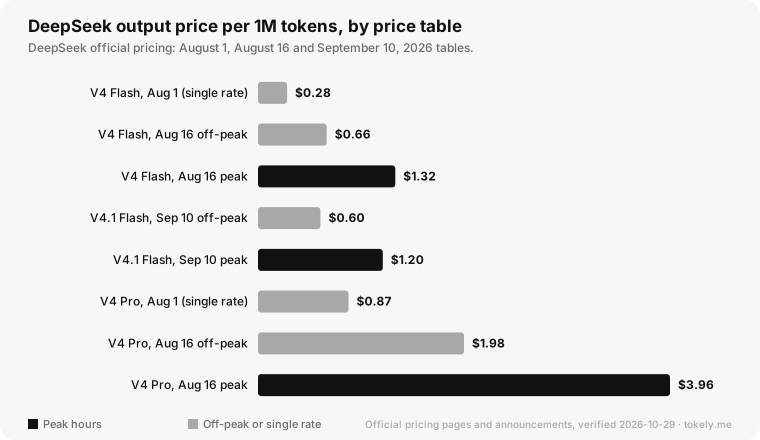
On August 1, 2026, DeepSeek listed one rate per model. V4 Flash cost $0.14 per 1M input tokens on a cache miss, $0.0028 on a cache hit and $0.28 for output. V4 Pro cost $0.435 input, $0.003625 on a cache hit and $0.87 output. The same page said that peak and off-peak pricing was coming, with peak prices at 2x.
DeepSeek's August 13 announcement set new prices from 16:00 UTC on August 16, 2026. V4 Flash moved to $0.22 input and $0.66 output off-peak, and $0.44 input and $1.32 output at peak. V4 Pro moved to $0.66 input and $1.98 output off-peak, and $1.32 input and $3.96 output at peak. Peak hours are 01:00 to 04:00 and 06:00 to 10:00 UTC.
Against the August 1 rates, V4 Flash output costs 4.7x at peak and 2.4x off-peak. V4 Pro output costs 4.6x at peak and 2.3x off-peak, and V4 Pro peak input is 3.0x. These V4 Pro prices are the ones DeepSeek still lists on October 29.
On September 10, 2026, DeepSeek released V4.1 Flash with its own table: $0.15 input, $0.003 cache hit and $0.60 output off-peak, and $0.30, $0.006 and $1.20 at peak. Peak hours now apply on weekdays only; weekends and Chinese public holidays are off-peak. V4.1 Flash output is still 2.1x the August 1 V4 Flash rate off-peak and 4.3x at peak. The $1.32 output price quoted in recent coverage matches the August 16 peak rate of V4 Flash, and Alibaba Cloud Singapore still lists deepseek-v4-flash-0731 at $0.44 input and $1.32 output in busy hours.
Finding 2: The generation premium
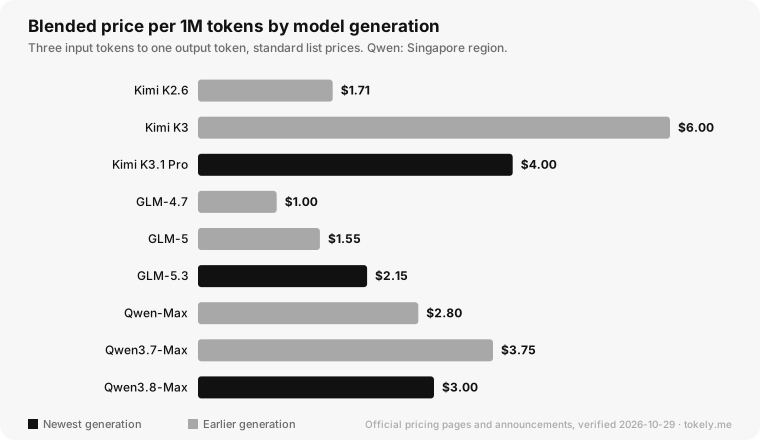
We define the generation premium as the blended price of a developer's newest flagship divided by the blended price of its last earlier generation, at the prices listed on the same day. On October 29, 2026, it is 2.34x for Kimi and 2.15x for GLM.
Kimi K2.6 lists at $0.95 input and $4 output, $1.71 blended. Kimi K3 lists at $3 and $15, $6.00 blended or 3.5x K2.6. Kimi K3.1 Pro lists at $2 and $10, $4.00 blended or 2.34x K2.6. Kimi's pricing page says the K2 series closes to new users on October 31, 2026 and will be retired by the end of December 2026, so new accounts start from the K3 price level.
GLM-4.5, GLM-4.6 and GLM-4.7 all list at $0.60 input and $2.20 output, $1.00 blended. GLM-5 lists at $1 and $3.20, 1.55x. GLM-5.1, GLM-5.2 and GLM-5.3 all list at $1.40 and $4.40, $2.15 blended or 2.15x GLM-4.7.
Finding 3: Qwen and MiniMax break the pattern
In Alibaba's Singapore region, Qwen-Max lists at $1.60 input and $6.40 output, $2.80 blended. Qwen3.7-Max lists at $2.50 and $7.50, $3.75 blended. Qwen3.8-Max lists at $2 and $6, $3.00 blended, which is 1.07x Qwen-Max and below Qwen3.7-Max.
The Qwen Plus line shows the same mix. Qwen-plus lists at $0.40 input and $1.20 output without thinking ($4 with thinking), $0.60 blended. Qwen3.5-Plus lists at $0.40 and $2.40, Qwen3.6-Plus at $0.50 and $3, and Qwen3.7-Plus at $0.40 and $1.60, $0.70 blended or 1.17x qwen-plus, with a limited-time 20% discount on top.
For Qwen, the region matters more than the generation. In Alibaba's China (Beijing) region, Qwen-Max lists at $0.345 input and $1.377 output and Qwen3.8-Max at $1.65 and $4.951, a 4.1x blended gap. In Singapore the same pair differs by 1.07x.
MiniMax M3 lists at $0.30 input and $1.20 output for inputs up to 512K tokens, after a discount the page labels permanent, from $0.60 and $2.40. MiniMax M3.1 Flash lists at $0.15 and $0.60.
Finding 4: Kimi K3.1 Pro lists at the same price as GPT-6.1 Sol and Claude Sonnet 5.5
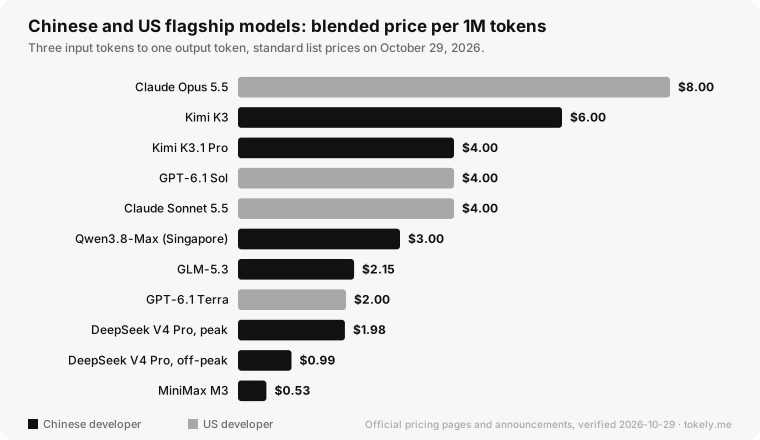
Kimi K3.1 Pro, OpenAI GPT-6.1 Sol and Anthropic Claude Sonnet 5.5 all list at $2 input and $10 output, $4.00 blended. On cached input, Kimi K3.1 Pro lists at $0.20, while GPT-6.1 Sol and Sonnet 5.5 list at $0.10. Kimi K3, at $3 and $15, lists at 1.5x Sonnet 5.5. Claude Opus 5.5 lists at $4 and $20, $8.00 blended.
Below that price point are Qwen3.8-Max at $3.00 blended, GLM-5.3 at $2.15 (0.54x Sonnet 5.5) and GPT-6.1 Terra at $1 input and $5 output, $2.00 blended. DeepSeek V4 Pro is $1.98 blended at peak and $0.99 off-peak, and MiniMax M3 is $0.53. The cheapest flagship-class options in this study are still Chinese, but the newest Kimi flagship sits at the US price point.
Finding 5: Small US models list below Chinese flash models
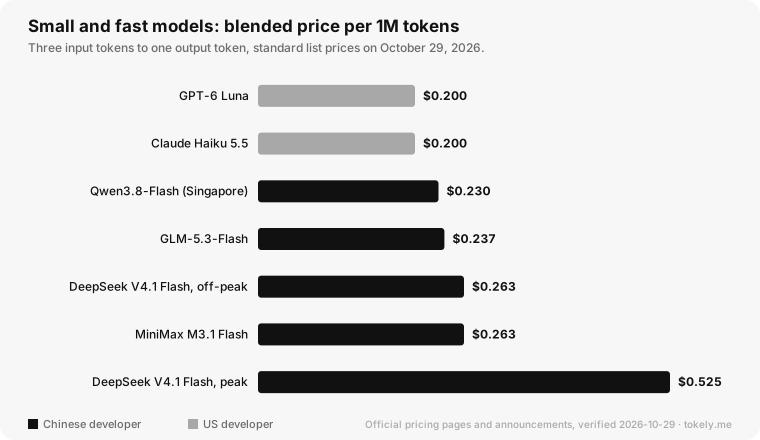
GPT-6 Luna and Claude Haiku 5.5 both list at $0.10 input and $0.50 output, $0.200 blended (Haiku 5.5 for prompts up to 100K tokens). Qwen3.8-Flash in Singapore lists at $0.15 and $0.47, $0.230 blended, and GLM-5.3-Flash at $0.15 and $0.50, $0.237. DeepSeek V4.1 Flash off-peak and MiniMax M3.1 Flash both list at $0.15 and $0.60, $0.263 blended or 1.31x GPT-6 Luna. DeepSeek V4.1 Flash at peak is $0.525.
Chinese small models keep a clear lead on cached input. DeepSeek V4.1 Flash cache hits cost $0.003 per 1M tokens off-peak, against $0.01 for GPT-6 Luna and Haiku 5.5, and MiniMax M3.1 Flash cache reads cost $0.015. Workloads that resend a long, repeated prefix, such as agents with large system prompts, pay less on DeepSeek.
What should teams do with this?
On DeepSeek, price by the hour. Off-peak rates are half of peak, and peak runs 01:00 to 04:00 and 06:00 to 10:00 UTC on weekdays, so batch jobs scheduled outside those windows pay the lower rate. Also check where you buy: Alibaba Cloud Singapore lists DeepSeek V4 Pro at a flat $2.40 input and $4.80 output, 1.8x DeepSeek's own peak input price and 3.6x its off-peak input price.
Re-check the assumption that a Chinese model is always the cheaper choice, model by model. Kimi K3.1 Pro lists at the same price as GPT-6.1 Sol and Sonnet 5.5, and small US models list below Chinese flash models, while DeepSeek off-peak, MiniMax M3 and GLM-5.3 still list well below US flagships. Teams on Kimi K2 models should plan for the cutoff for new users on October 31, 2026.
Tokely gives one API key for DeepSeek, Qwen, Kimi, GLM, MiniMax, OpenAI, Anthropic and other models, so you can compare and switch them in one place: Tokely models.
Frequently asked questions
Are Chinese AI APIs still cheaper than OpenAI and Anthropic? Not across the board. DeepSeek V4 Pro off-peak ($0.99 blended), MiniMax M3 ($0.53) and GLM-5.3 ($2.15) list below Claude Sonnet 5.5 and GPT-6.1 Sol ($4.00), but Kimi K3.1 Pro lists at the same $2 input and $10 output, and GPT-6 Luna and Claude Haiku 5.5 ($0.200) list below the Chinese flash models in this study.
Why are the newest Qwen, Kimi and GLM flagships priced higher than earlier versions? This study compares list prices and does not cover the reasons behind them. What the price pages show on October 29, 2026 is a generation premium of 2.34x for Kimi and 2.15x for GLM, while Qwen3.8-Max in Singapore lists at 1.07x Qwen-Max.
Which Chinese models list close to their earlier versions? MiniMax M3 lists at $0.30 input and $1.20 output after a permanent 50% discount, Qwen3.8-Max in Singapore lists at 1.07x Qwen-Max, and Qwen3.7-Plus at 1.17x qwen-plus.
Did DeepSeek raise its API prices? Yes. From 16:00 UTC on August 16, 2026, DeepSeek replaced single rates with peak and off-peak prices: V4 Flash output went from $0.28 to $0.66 off-peak and $1.32 at peak, and V4 Pro output from $0.87 to $1.98 and $3.96. V4.1 Flash, released September 10, lists at $0.60 off-peak and $1.20 at peak.
How can I pay less for Chinese models? Send DeepSeek traffic outside peak hours (01:00 to 04:00 and 06:00 to 10:00 UTC on weekdays), reuse long prompt prefixes so they bill at cache-hit rates such as DeepSeek's $0.003 per 1M tokens, compare regions on Alibaba Cloud, and check reseller prices against the developer's own page.
Methodology and limitations
Prices are official list prices verified October 29, 2026, and every row in the CSV carries a source URL. We used the standard tier and the lowest context band unless noted. Batch discounts, cache-write fees, enterprise contracts, free quotas, taxes and limited-time promotions are excluded: the Qwen3.7-Plus 20% discount is not applied, while MiniMax's permanent 50% discount is applied because the page lists it as the standard rate. Qwen uses Singapore prices, and other regions differ.
Generations are ordered by version number. Except for DeepSeek, this study does not track price history: earlier-generation prices are the ones listed on October 29, 2026. DeepSeek's August 1 prices come from an archived copy of its pricing page (Internet Archive, captured August 1, 2026). The 3:1 blend is our assumption, and output-heavy workloads change the ratios. We did not measure quality, speed or tokens per task, which differ between models.
Data and citation
Both datasets are free to download: list prices for 34 model rows with source URLs, chinese-ai-model-api-prices-2026.csv, and DeepSeek's dated price tables, deepseek-api-price-history-2026.csv.
Cite as: Tokely (2026). Are Chinese AI Models Getting More Expensive? API Prices by Generation (2026). https://tokely.me/blog/chinese-ai-model-api-prices-2026