 Tokely
Research scope: This study is a snapshot: plan prices and API list prices from official pages read on November 5, 2026. Session costs are calculated from stated assumptions and are not observations of any real agent; break-even figures use the averages Anthropic publishes for Claude Code and ignore plan limits.
THE SHORT ANSWER
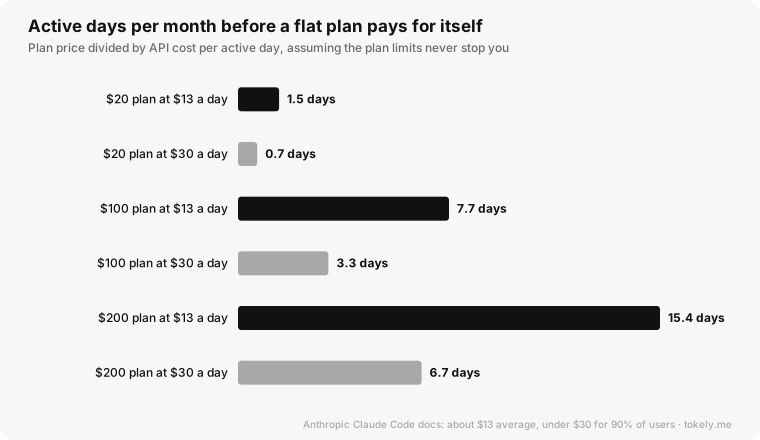
At Anthropic's average of $13 per active day, flat plans at $20, $100 and $200 pay for themselves in 1.5, 7.7 and 15.4 active days if limits do not stop you. Only GitHub Copilot of the four vendors states its allowance in money. On the API, the long-session premium reaches 1.79x to 4.53x.
What did we compare?
We compared two things: the published plans of four coding agents (Claude Code, OpenAI Codex, GitHub Copilot and Cursor) and a model of API cost. All session numbers in this analysis come from an explicit mathematical model rather than observations of any real agent.
The modeled session consists of 100 sequential API calls. The session starts with a 20,000-token context that is written to prompt cache on the very first call. Every subsequent call resends the entire accumulated prior context as a cache read, writes new tokens to the cache and receives 500 output tokens.
We modeled three session sizes that differ solely by the volume of new tokens added per step. The Short session adds 500 tokens per call and ends at a prompt size of 69,500 tokens. The Medium session adds 2,000 tokens per call to reach 218,000 tokens, while the Long session adds 6,000 tokens per call to finish at 614,000 tokens. These synthetic scenarios serve as illustrative assumptions to test how pricing schedules behave as contexts expand.
Finding 1: Flat plans break even within days, if limits hold
Anthropic's published documentation for Claude Code reports an average enterprise cost of around $13 per developer per active day. That benchmark places full-month usage between $150 and $250 per developer, with costs remaining below $30 per active day for 90% of users. Dividing a flat subscription price by the daily API spend produces the break-even threshold in active working days.
At the $13 daily average, a $20 entry plan breaks even after 1.5 active days of development. A $100 plan requires 7.7 active days to break even, while a $200 tier requires 15.4 active days. For higher-intensity users spending $30 per active day, those break-even requirements compress to 0.7 days for a $20 plan, 3.3 days for a $100 plan and 6.7 days for a $200 plan.
Against Anthropic's reported monthly range of $150 to $250, direct API spend sits above the $100 Max plan price and around the $200 Ultra price. These calculations hold only if plan limits do not stop you first, and vendors publish those limits in very different ways.
Finding 2: Only one vendor states the allowance in money
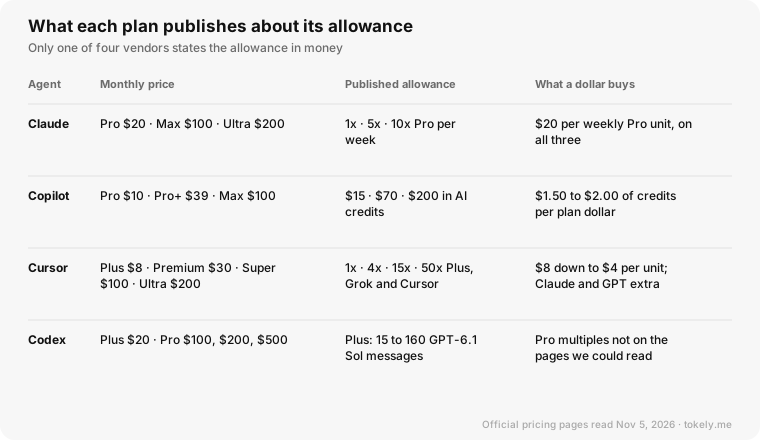
Across the four evaluated tools, only GitHub Copilot defines its plan allowances directly in currency. Its $10 Pro tier includes $15 in AI credits, the $39 Pro+ tier includes $70, and the $100 Max tier includes $200. These credits draw down at published token consumption rates, and Copilot lists token rates for Claude Opus 5.5, Claude Sonnet 5.5 and GPT-6.1 Sol that match the respective model providers' public API price sheets.
Claude structures its tiers around relative capacity multipliers rather than token totals. Pro lists at $20 for 1x allowance, Max lists at $100 for 5x, and Ultra lists at $200 for 10x the Pro weekly limit. This pricing keeps the cost per weekly Pro unit at exactly $20 across all three tiers, making the annual Pro plan at $17 per month the lowest unit rate available. Anthropic publishes no explicit token or message volumes for these plans, though Ultra removes the five-hour restriction for verified accounts.
Anthropic includes $100 and $200 in monthly Claude Platform API credits with Max and Ultra plans, but Anthropic says those credits cannot be used in Claude Code. Cursor similarly isolates its included allowances to its own internal models and Grok across its $8 Plus, $30 Premium, $100 Super and $200 Ultra plans, which scale at 1x, 4x, 15x and 50x base capacity. Any calls to Claude or GPT models through Cursor require prepaid credits billed at full API list price for Premium users and above.
OpenAI Codex lists a range of 15 to 160 GPT-6.1 Sol local messages per five hours on its $20 Plus plan and offers Pro plans at $100, $200 and $500. We did not find multipliers between plans on the pages we could read. OpenAI pricing documentation explicitly cautions developers that API token prices are separate from subscription usage and should not be used to estimate included tasks. Respecting that guidance, our model does not attempt to convert Codex message allotments into dollar equivalents.
Finding 3: As sessions grow, output stops being the main cost
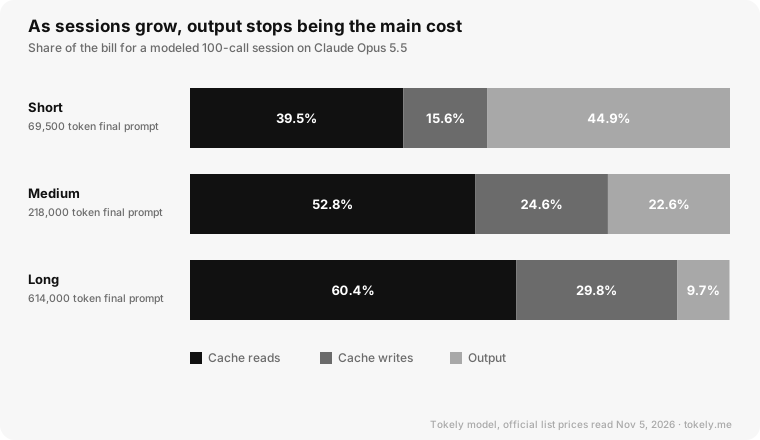
Token pricing on Claude Opus 5.5 charges $4 per million input tokens, $5 per million five-minute cache write tokens, $0.20 per million cache read tokens and $20 per million output tokens. In our simulated 100-call workload, the total bill lists at $2.23 for the Short session, $4.43 for the Medium session and $10.29 for the Long session. As context accumulates over sequential requests, the distribution of expenses shifts away from generation toward context maintenance.
Output generation represents 44.9% of the invoice on the Short session, but accounts for only 9.7% of the total on the Long session. Cache reads expand from 39.5% of total spend in the Short scenario to 60.4% in the Long scenario, while cache writes rise from 15.6% to 29.8%. Across all three modeled sizes, prompt cache reads account for roughly 97% to 98% of all processed tokens.
Without caching, the exact same three workloads on Opus 5.5 would list at $18.90, $48.60 and $127.80, representing cost increases of 8.5x, 11.0x and 12.4x. Because cache reads are nearly all the tokens in these modeled sessions, the cache-read rate moves the bill more than the headline input price. Comparing models on input and output prices alone misses most of the cost.
Finding 4: Equal list prices stop being equal in long sessions
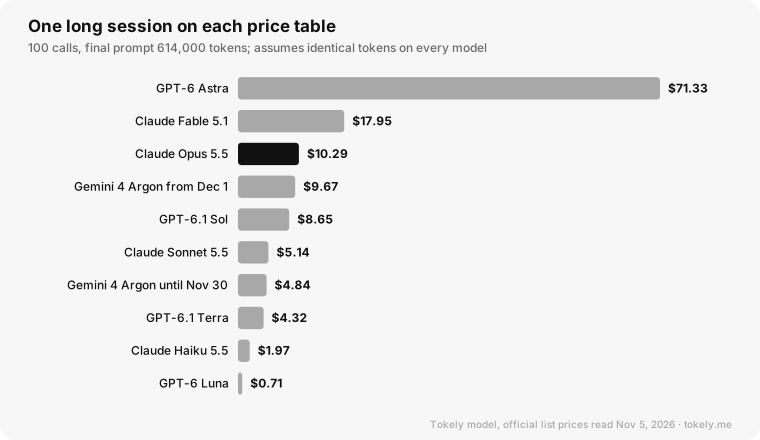
Applying identical token counts across other provider rate tables reveals sharp divergence during extended sessions. Assuming identical token consumption without assessing model output quality, the modeled Long session lists at $71.33 for GPT-6 Astra, $17.95 for Claude Fable 5.1, $10.29 for Claude Opus 5.5, $9.67 for Gemini 4 Argon from December 1, $8.65 for GPT-6.1 Sol, $5.14 for Claude Sonnet 5.5, $4.84 for Gemini 4 Argon until November 30, $4.32 for GPT-6.1 Terra, $1.97 for Claude Haiku 5.5 and $0.71 for GPT-6 Luna.
Matching headline rates can obscure major differences in deep contexts. Both GPT-6.1 Sol and Claude Sonnet 5.5 list standard prices of $2 per million input tokens, $0.10 for cached tokens and $10 for output tokens. Consequently, they bill identically at $1.11 in the Short session and $2.21 in the Medium session. In the Long session, Sol costs 1.68x more at $8.65 versus $5.14 for Sonnet, because OpenAI increases pricing tiers once prompt contexts exceed 272,000 tokens, a threshold crossed by 57 of the 100 calls in that simulation.
A similar divergence appears at higher price points. Both GPT-6 Astra and Claude Fable 5.1 publish headline rates of $10 per million input tokens and $50 per million output tokens. Astra costs 1.74x more than Fable in the Short session because Astra sets cached input at $1 per million versus $0.25 for Claude, and that gap widens to 3.97x in the Long session.
At the economy tier, Claude Haiku 5.5 and GPT-6 Luna both list $0.10 per million input tokens and $0.50 per million output tokens, resulting in a shared $0.08 cost for the Short session. Haiku, however, imposes a 5x rate multiplier on prompts exceeding 100,000 tokens. This pricing tier causes Haiku to cost 3.9x as much as Luna in the Medium session and 2.76x as much in the Long session.
Finding 5: The long-session premium
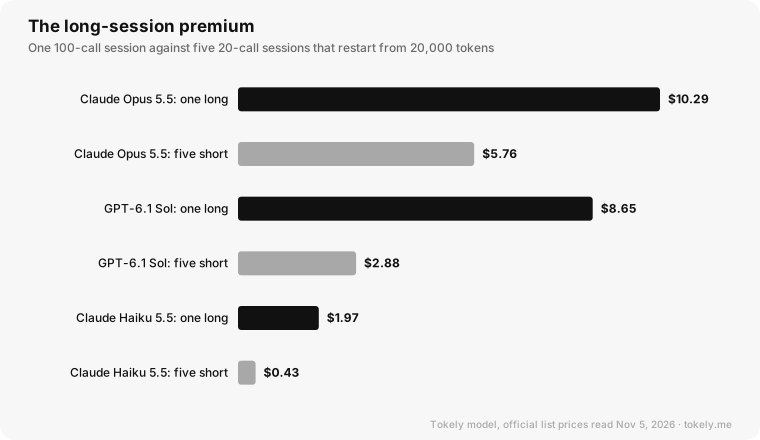
We define the long-session premium as what one 100-call session costs compared with five 20-call sessions that restart from a fresh 20,000-token context. It is 1.79x on Claude Opus 5.5, 3.01x on GPT-6.1 Sol and 4.53x on Claude Haiku 5.5. When an agent session runs continuously without resetting context, accumulating history inflates cache reads on every single request.
Evaluating our modeled Long session illustrates the scale of this effect. A single 100-call Long session adding 6,000 tokens per call on Claude Opus 5.5 lists at $10.29, compared to $5.76 across five segmented 20-call sessions at the same pace, yielding a 1.79x long-session premium. On GPT-6.1 Sol, the single session costs $8.65 compared to $2.88 across five segmented sessions, representing a 3.01x premium. On Claude Haiku 5.5, the single run costs $1.97 against $0.43 for the segmented alternative, reaching a 4.53x premium.
The long-session premium expands most aggressively when an extended run crosses a vendor's long-context pricing threshold. The five shorter sessions write slightly more prompt tokens overall, totaling 670,000 tokens against 614,000 tokens for the single unified session, because each restart writes the initial context again. The savings assume the work really can restart without the earlier context, which is the catch.
Which should you pick?
Rule one requires pricing your specific development month. Compare expected direct API spend against fixed plan pricing based on your active coding cadence. If you activate an agent only one or two days each month, pay-per-token API billing can be the cheaper choice.
Rule two applies if you work most days mostly alone inside a single agent environment. A flat subscription plan usually wins on price under regular schedules, provided its limits fit your workflow. Hitting a limit costs time and not money. With Claude usage credits enabled, overflow activity continues at standard API rates, so the plan does not make extra usage more expensive than the API.
Rule three points to direct API integration when you build custom internal software, share access across an entire engineering team or combine multiple vendors in one pipeline. Claude plan limits cover Claude and Claude Code, but do not provide token allowances for your own standalone applications.
Rule four addresses optimization when operating directly over raw model APIs. Before committing to a provider, compare cached-input prices and long-context threshold surcharges rather than relying on headline input and output numbers. When managing active coding sessions, restart from a fresh context whenever earlier conversational turns are no longer required by the agent.
Frequently asked questions
Is a coding agent subscription cheaper than the API?
It depends on active days. At Anthropic's $13 daily average, flat plans break even in 1.5 to 15.4 active days, though developers using agents only a couple of days a month pay less on the API.
How much usage does Claude Pro include?
Anthropic publishes no token or message count for Claude Pro. Limits are stated as relative multiples of Pro per five hours and per week.
Do Max API credits work in Claude Code?
No, Anthropic states that the monthly API credits included with Max cannot be used in Claude Code or the Claude apps.
What happens when I hit a Claude plan limit?
You must wait for the limit window to reset, or continue at standard API rates if you enable usage credits.
Methodology and limitations
Session costs in this article represent mathematical calculations derived from assumed workloads rather than direct observations of Claude Code, Codex, Copilot or Cursor. Production agents exhibit varying context window behaviors, diverse prompt caching success rates and differing output lengths. A different underlying model may also require more or fewer tokens to complete an identical development task.
The break-even benchmarks rely on Anthropic's published Claude Code enterprise deployment averages, so individual developers and small teams may differ. The calculations also omit the impact of plan capacity limits, which most vendors do not publish in comparable units. We assumed that all cache writes use Anthropic's five-minute rate and OpenAI's 30-minute rate, that new tokens on Gemini 4 Argon, which uses implicit caching, bill at the input price, and that long-context thresholds count the whole prompt per request.
Gemini 3.8 Flash is excluded from this model because its cache storage fees depend on how long content remains cached. Plan prices and API rates reflect public web pages accessed on November 5, 2026, which do not display absolute publication dates. Because two OpenAI help pages returned errors to our fetcher, Codex details come from chatgpt.com/codex/pricing and official OpenAI pricing documentation. We ran no paid requests for this study.
Data and citation
All modeled session figures are compiled in a free CSV file that contains every assumption and price, formatted with one row per model and session size. Cite as: Tokely, "Claude Code, Codex, Copilot and Cursor Plans vs API: Break-Even and the Cost of Long Sessions", November 2026, https://tokely.me/blog/coding-agent-plans-vs-api-cost-2026.