 Tokely
Research scope: This study compares official list prices for one generated image, read from the pricing pages of OpenAI, Google (Gemini API), ByteDance (BytePlus), Alibaba (Model Studio, international rates), xAI and Black Forest Labs on November 18, 2026. The standard setting is one image at 1K or the default size, at medium quality where a quality choice exists; input costs are excluded. It is a snapshot of current prices, not a price history, and it does not measure image quality.
THE SHORT ANSWER
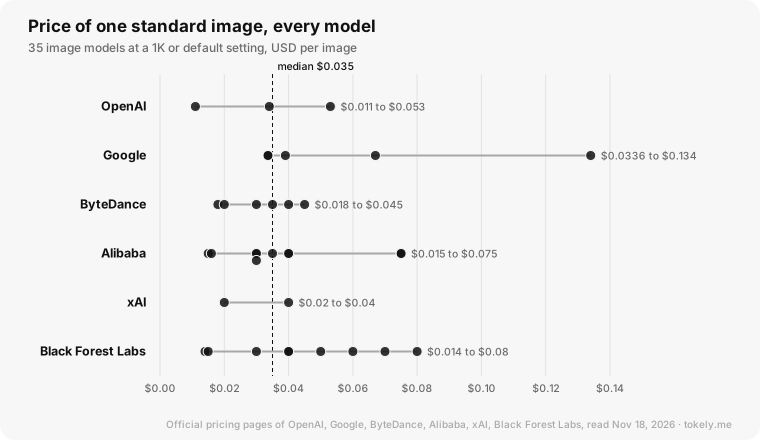
We compared the official list prices of 35 image generation models from six developers on November 18, 2026. The median standard image costs $0.035, 25 of the 35 models list at $0.04 or less, and the range runs from $0.011 (GPT Image 1 mini) to $0.134 (Nano Banana Pro). The bigger lever is what we call the Quality Dial: one quality setting on GPT-Image-2 moves its price 35.2x, while the whole market spans 12.2x.
What did we compare?
This research compiles official pricing pages for OpenAI, Google, ByteDance, Alibaba, xAI, and Black Forest Labs. We verified every data point against the developer websites on November 18, 2026. Prices reflect the list cost for one generated image in USD. The dataset covers 35 image generation models. We excluded video models, GPT-Image-2.5 and GPT-Image-2.6 (Sunburst and Flare) because they use token-based billing and lack a per-image table, the discontinued GPT Image 1, and Imagen, which does not appear on the Gemini API pricing page. The model count per developer is: Alibaba 10, Black Forest Labs 9, ByteDance 6, Google 5, OpenAI 3, and xAI 2. We define a standard price as one output image at 1K resolution or the default size, using the medium quality setting where available or the lowest quality setting where only low and medium options exist. Input costs for prompt text or reference images are excluded from these calculations.
Finding 1: Most images cost 2 to 4 cents
The median standard price is $0.035 per image. A large portion of the market, 25 of the 35 models, lists at $0.04 or less. The median prices segmented by developer offer a clearer look at market tiers. OpenAI holds a median of $0.034 across three models, with a range from $0.011 to $0.053. Alibaba models show a median of $0.0325, spanning $0.015 to $0.075. ByteDance models also hold a median of $0.0325, with a range of $0.018 to $0.045. xAI models show a median of $0.03, ranging from $0.02 to $0.04. Black Forest Labs maintains a median of $0.04, with costs from $0.014 to $0.08. Google models sit at a median of $0.039, ranging from $0.0336 to $0.134.
The most budget-friendly standard images include GPT Image 1 mini at $0.011, FLUX.2 [klein] 4B at $0.014, and FLUX.2 [klein] 9B at $0.015. Z-Image Turbo also lists at $0.015. Seedream 5.0 Flash costs $0.018, Seedream 5.5 costs $0.020, and Grok Imagine Image costs $0.02. At the top of the price range, Nano Banana Pro lists at $0.134. FLUX.1 Kontext [max] costs $0.08, Qwen-Image 2.0 Pro costs $0.075, and Wan 2.7 Image Pro also costs $0.075. FLUX.2 [max] begins at $0.07, while Nano Banana 2 lists at $0.067. Product teams choosing models based on unit economics should note that the spread between the cheapest and most expensive standard image is 12.2x.
Finding 2: The Quality Dial
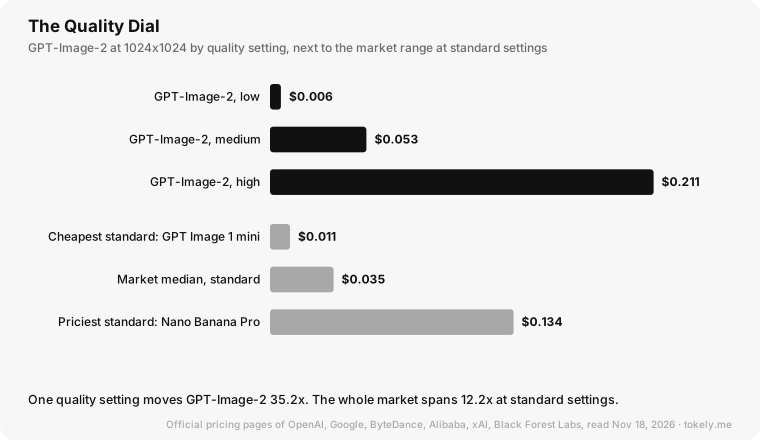
We define "the Quality Dial" as the cost variation introduced by quality settings on a single model. This variable creates a wider price swing than the entire breadth of the standard market. For example, GPT-Image-2 at 1024x1024 costs $0.006 at low quality, $0.053 at medium quality, and $0.211 at high quality. This represents a 35.2x increase from the low setting to the high setting. Other models show similar, though smaller, ranges. GPT Image 1.5 spans from $0.009 at low to $0.133 at high, a 14.8x increase. GPT Image 1 mini spans from $0.005 at low to $0.036 at high.
These internal model settings create significant financial variance. Across all 35 models at standard settings, the price spread is 12.2x, ranging from $0.011 to $0.134. One individual model configuration, such as GPT-Image-2, creates a range 2.9 times wider than the variation between the cheapest and priciest standard models in the market. Other developers employ milder dials. Grok Imagine Image 2.0 lists at $0.04 for a 1K low-quality image and $0.06 for a 1K medium-quality image, a 1.5x increase. On OpenAI a horizontal 1536x1024 image can cost less than a square one at the same quality: GPT-Image-2 at high quality lists at $0.211 square and $0.165 horizontal.
Finding 3: Resolution is the second dial
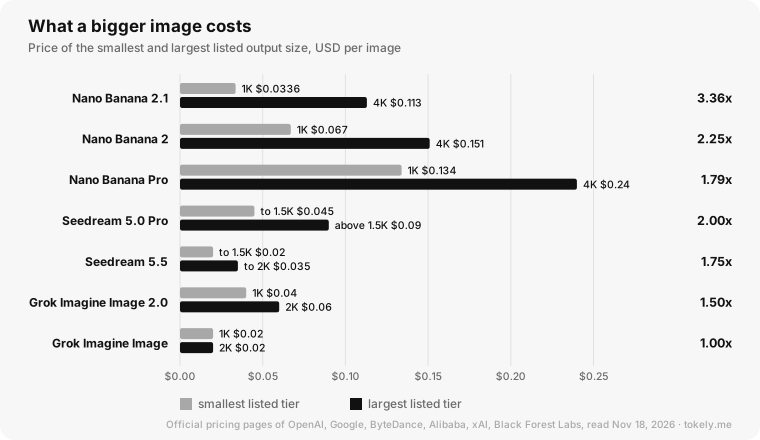
Resolution serves as the second major lever for cost. On models that publish size tiers, the largest listed size often costs 1.5x to 3.4x more than the smallest tier. Nano Banana 2.1 provides a clear example: it lists at $0.0336 at 1K, $0.0504 at 2K, and $0.113 at 4K. This represents a 3.36x range from the smallest to the largest output. Nano Banana 2 lists at $0.067 at 1K and $0.151 at 4K, a 2.25x increase. Nano Banana Pro lists at $0.134 at 1K or 2K, and $0.24 at 4K, a 1.79x increase.
ByteDance models demonstrate similar scaling. Seedream 5.0 Pro lists at $0.045 for images up to 1.5K and $0.09 for images above that size, a 2x increase. Seedream 5.5 lists at $0.020 for images up to 1.5K and $0.035 for images up to 2K, a 1.75x increase. Grok Imagine Image 2.0 lists at $0.04 at 1K low and $0.06 at 2K low, a 1.5x increase. The original Grok Imagine Image maintains a flat $0.02 price at both 1K and 2K sizes. Other price lists contain specific billing mechanics. Black Forest Labs rounds FLUX.2 resolution up to the next megapixel, meaning a 1920x1080 image is 2.07 megapixels but gets billed as 3 megapixels. Google offers a batch mode for Nano Banana 2.1 at $0.0168 per 1K image, which is half the standard rate. Z-Image Turbo charges $0.015 when prompt rewriting is off and $0.03 when it is enabled.
Finding 4: Newer models list lower in 5 of 7 lines
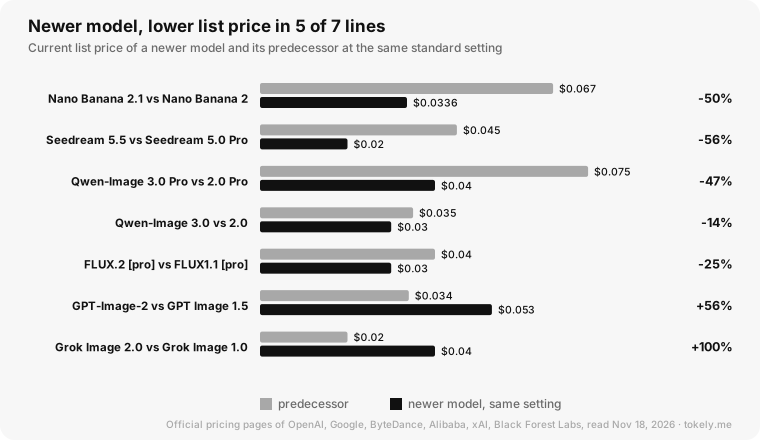
Comparing current list prices of newer models and their predecessors at the same standard setting, the newer model is cheaper in five of seven product lines. Nano Banana 2.1, released on October 6, 2026, lists at $0.0336, which is half the price of Nano Banana 2 at $0.067. Google has announced the deprecation of Nano Banana 2. Seedream 5.5 lists at $0.020 compared to Seedream 5.0 Pro at $0.045, 56% lower. The Qwen-Image line shows a similar pattern. Qwen-Image 3.0 Pro lists at $0.04 versus Qwen-Image 2.0 Pro at $0.075, 47% lower. Qwen-Image 3.0 lists at $0.03 compared to Qwen-Image 2.0 at $0.035, 14% lower. FLUX.2 [pro] lists from $0.03 compared to FLUX1.1 [pro] at $0.04, 25% lower.
Two product lines move in the other direction. GPT-Image-2 at medium quality lists at $0.053 versus GPT Image 1.5 at $0.034, which is 56% higher. However, at the low-quality tier, GPT-Image-2 is $0.006 compared to $0.009 for the predecessor. Grok Imagine Image 2.0 starts at $0.04, which is twice the $0.02 price of the original Grok Imagine Image. Product teams should evaluate both the list price and the quality or feature set of the newer models to decide whether the price difference fits their requirements.
What should you budget per image?
Teams should select models and settings based on practical price points observed in the current data. For high-volume tasks such as bulk drafts and previews, the most efficient models include GPT-Image-2 at low quality for $0.006, GPT Image 1 mini at medium quality for $0.011, and FLUX.2 [klein] models ranging from $0.014 to $0.015. Z-Image Turbo at $0.015 and Seedream 5.0 Flash at $0.018 are also viable options for cost-sensitive operations. The 2 to 3.5 cent middle includes Seedream 5.5 at $0.020, Qwen-Image 3.0 at $0.03, Wan 2.7 Image at $0.03, FLUX.2 [pro] starting at $0.03, Nano Banana 2.1 at $0.0336, and GPT Image 1.5 at medium quality for $0.034.
Budgeting for 4K output requires careful calculation, as these costs increase significantly compared to 1K output. Nano Banana 2.1 at 4K costs $0.113, while Nano Banana Pro at 4K reaches $0.24. We advise teams to explicitly fix quality and size in their API requests. These two variables move the final bill more than the choice of vendor. Teams should also measure input costs separately, as some models include additional fees. For instance, Seedream 5.0 Pro charges $0.003 per input image after the first. By setting strict size and quality parameters, teams can avoid unexpected budget overruns regardless of the chosen model.
Methodology and limitations
This article provides a snapshot of list prices on November 18, 2026, and does not analyze price history. Release dates are used only to order models within a line. The definition of a standard setting differs slightly by vendor: Seedream bills by pixel tier, FLUX.2 bills by megapixel with starting prices, and Alibaba rates reflect the international Singapore list. These prices exclude prompt text, reference image input, taxes, free quotas, enterprise discounts, and regional variants. This report does not measure image quality, generation speed, or prompt adherence. No images were generated for this study.
Data and citation
The CSV lists 35 models with developer, price per image, setting, release date where published, source URL and check date. Cite as: Tokely (2026), "How Much Does an AI Image Cost? Image Generation API Prices of 35 Models", https://tokely.me/blog/image-generation-api-prices-2026.