 Tokely
Research scope: This study compares official list prices and API docs of web search APIs and model-native search tools as of October 27, 2026. It is a price snapshot: model tokens, result quality and latency were not measured. DeepSeek per-request billing starts November 1, 2026.
THE SHORT ANSWER
Web search API list prices span from $0.75 to $35 per 1,000 searches across 13 pricing tiers from eight providers. This creates a 47x spread between the lowest and highest cost options. Model-native tools carry the grounding premium, listing at 2x to 2.8x the median standalone search API.
What did we measure?
This comparison tracks 13 price tiers across eight providers, dividing them into seven standalone search API tiers and six search tools integrated directly into model APIs. The standalone options cover DeepSeek, Perplexity, Exa, Brave, and Tavily. The model-native group includes search tools inside OpenAI, Anthropic, and Google Gemini APIs.
For each tier, we recorded the list price per 1,000 search requests, the maximum results returned per request, whether page content or a dedicated page-fetch endpoint is available, the price of that fetch feature, and any free monthly tier allowance. Every figure comes directly from each provider's official pricing documentation, verified on October 27, 2026. All listed prices exclude model token charges. The complete dataset is available as a CSV file below.
Finding 1: A 47x spread between the cheapest and most expensive search
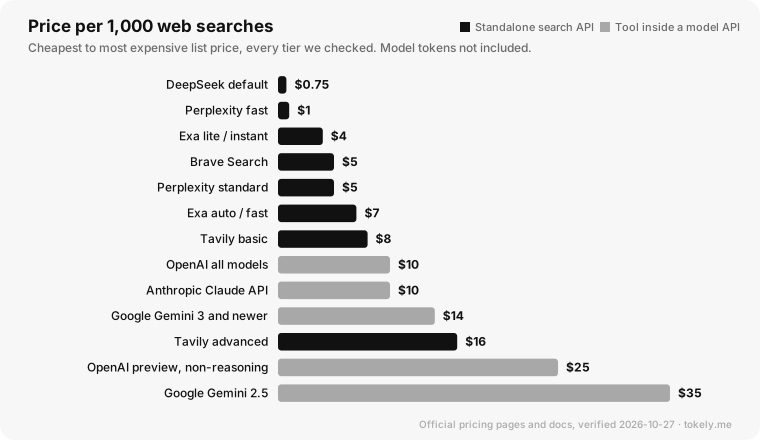
List prices per 1,000 search requests begin at $0.75 and reach $35. DeepSeek Search lists at $0.75, Perplexity Search fast lists at $1, Exa lite or instant lists at $4, Brave Search lists at $5, and Perplexity Search standard lists at $5. Moving up the range, Exa auto or fast lists at $7, Tavily basic lists at $8 based on one credit at $0.008, the OpenAI web search tool lists at $10, and the Anthropic web search tool lists at $10.
At the high end, Google grounding for Gemini 3 and newer lists at $14, Tavily advanced lists at $16 for two credits, the OpenAI web search preview tool for non-reasoning models lists at $25, and Google grounding for Gemini 2.5 lists at $35 per 1,000 grounded prompts. Dividing $35 by $0.75 yields a 46.7 ratio, establishing an approximate 47x spread between the extremes. DeepSeek bills only for successful requests. Its per-request billing begins at 00:00 Beijing time on November 1, 2026, with calls routed through DeepSeek Harness, Claude Code, or Codex remaining free until that timestamp.
Finding 3: Reading pages, not just searching, changes the ranking
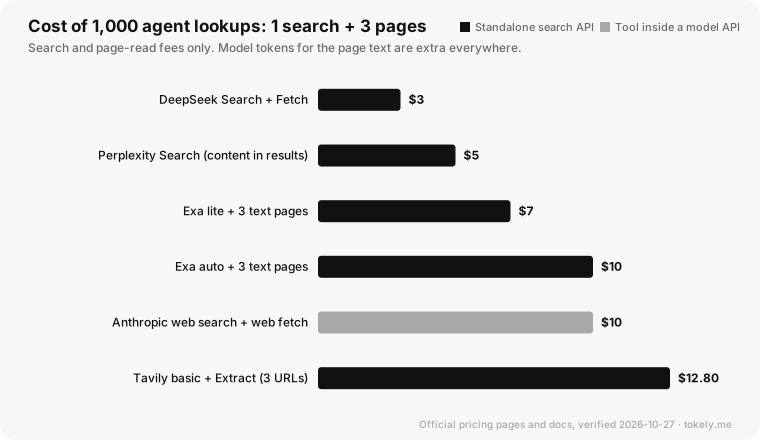
Evaluating full agent workflows requires looking beyond query pricing. Defining a standard agent lookup as one search plus reading three target result pages reveals a different cost hierarchy. At 1,000 lookups, counting only tool and fetch fees, DeepSeek Search costs $3.00, calculated as $0.75 for search plus three Fetch requests at $0.75 each. Perplexity Search costs $5.00 flat because search results already include extracted page text bounded by max_tokens_per_page.
Exa lite reaches $7.00 per 1,000 lookups, consisting of $4 for search plus three text pages at $1 per 1,000 pages. Exa auto totals $10.00, combining its $7 search price with $3 for three text page fetches. Anthropic web search also totals $10.00, pairing its $10 search fee with web fetch at no extra tool charge. Fetched page text is billed as model input tokens, which Anthropic docs estimate at roughly 2,500 tokens for an average 10 kB web page.
Tavily basic reaches $12.80 per 1,000 lookups, combining its $8 search fee with Extract billed at one credit per five URLs, which equals $1.60 per 1,000 pages. Brave Search is omitted from this comparison because it returns snippets, with up to five extra snippets per result, and lists no page-fetch product on its pricing page. Across every provider, model tokens required to ingest fetched page text are billed separately.
Finding 4: Per result, DeepSeek is 17x cheaper than the next API
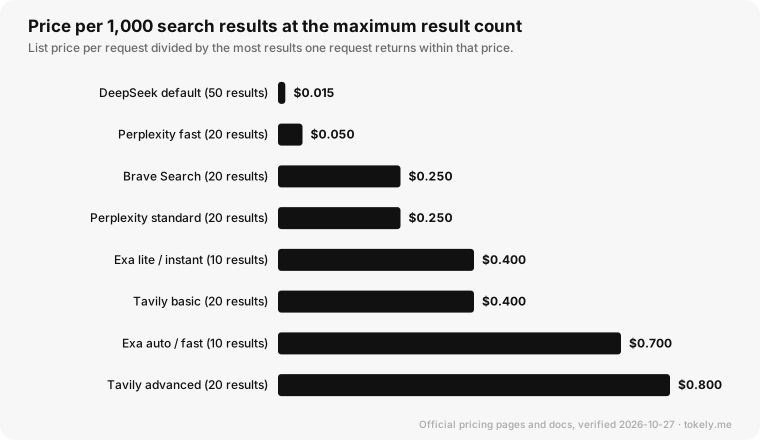
Comparing the list price against the maximum results delivered in a single request changes provider unit economics. DeepSeek costs $0.015 per 1,000 returned results based on its cap of 50 results per query. Perplexity fast costs $0.05 per 1,000 results with a 20-result cap. Brave Search costs $0.25 per 1,000 results with 20 results, matching Perplexity standard at $0.25 per 1,000 results for 20 results.
Exa lite lists at $0.40 per 1,000 results, covering 10 included results, with additional results priced at $1 per 1,000. Tavily basic costs $0.40 per 1,000 results across 20 results. Exa auto costs $0.70 per 1,000 results with 10 results included, while Tavily advanced lists at $0.80 per 1,000 results across 20 results. At $0.015, DeepSeek is 16.7x cheaper per result than Brave or Perplexity standard at $0.25, and 3.3x cheaper than Perplexity fast at $0.05.
Returned payloads also vary in structure. DeepSeek includes a rerank score from 0 to 3, an authority tier from 0 to 4, and an extracted summary between 600 and 800 characters targeted at model consumption. For Perplexity, a single billed search request can accept up to five queries at once while counting as one unit.
Finding 5: Free tiers cover prototypes, not production
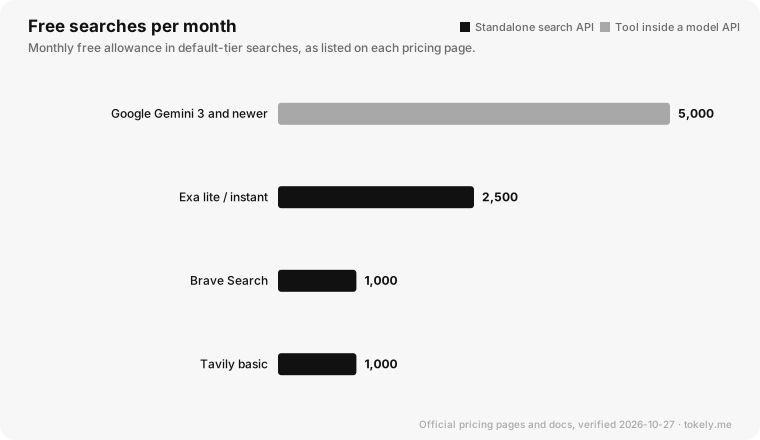
Free monthly allowances differ widely across providers. Google grounding provides 5,000 free search requests per month shared across Gemini 3 and newer model tiers. Exa offers $10 in monthly platform credits, translating to up to 2,500 Lite searches. Brave provides $5 in monthly credits, which covers 1,000 searches at its $5 per 1,000 rate. Tavily includes 1,000 API credits each month, providing 1,000 basic search calls.
An agent architecture executing 3,000 lookups per month, or about 100 per day, exceeds the free allocations of Exa, Brave, and Tavily. Only Google's Gemini 3 grounding allowance covers this monthly query volume without payment. We found no monthly free search allowance on the DeepSeek, OpenAI, and Anthropic pages we checked.
Rate limit ceilings also introduce practical boundaries between APIs. Brave lists 50 queries per second for its Search plan. DeepSeek assigns accounts a cap of 100 queries per second for its Search API and 25 queries per second for its Fetch endpoint.
What should teams do with this?
For high-volume agents that execute multiple web searches per user task, standalone search APIs cost less per search. At $0.75 to $8 per 1,000 queries, these tools run at a fraction of the $10 to $14 per 1,000 fees charged by native model tools. A standalone API also lets the developer filter, rank, and truncate raw web data before injecting it into the prompt context.
For low-volume applications or rapid prototyping, native model tools remove infrastructure complexity. Paying the grounding premium adds $2 to $9 per 1,000 queries over a $5 standalone baseline and avoids a separate search dependency. The model manages its own search invocations without intermediate orchestration code.
Engineering teams must calculate full page reads and input tokens when estimating production expenses. A multi-step lookup that reads three full web pages generates $3 to $12.80 in tool charges alone per 1,000 operations before any token billing occurs. Tokely gives one API key for OpenAI, Anthropic, Google, DeepSeek and other models, so the model side of an agent can be priced and switched in one place: Tokely pricing.
Methodology and limitations
This research reflects official list prices and API documentation verified on October 27, 2026, with every data point linked to a source URL in the companion dataset. Default tiers represent the pricing applied when a request omits optional parameters, whereas Perplexity fast and Exa lite require explicit opt-in configuration. DeepSeek pricing applies to production billing starting November 1, 2026.
This analysis excludes enterprise contracts, private volume discounts, Tavily's $30 monthly Project plan (4,000 credits at $7.50 per 1,000 basic searches), Exa Answer ($5 per 1,000 requests), specialized research agents, answer endpoints, model token charges, and taxes. The lookup model assumes one search plus three page fetches per task. Tavily Extract bills per five successful URLs, meaning a three-URL batch may incur rounding effects. We did not benchmark search latency, index coverage, or result quality.
Data and citation
The complete dataset containing 13 provider tiers, prices per 1,000 requests, maximum result limits, fetch pricing, free tiers, and direct documentation links verified on October 27, 2026, is available for download: web-search-api-prices-2026.csv.
Cite as: Tokely (2026). Web Search API Pricing for AI Agents: 8 Providers Compared (2026). https://tokely.me/blog/web-search-api-pricing-2026