 Tokely
THE SHORT ANSWER
The Department of Homeland Security ordered federal civilian agencies to stop buying DeepSeek products and to remove them, including third-party products built using DeepSeek implementations, from their IT. Private companies are not directly restricted, but software vendors to civilian agencies are affected. At list prices, GPT-5 nano and GPT-6 Luna cost less than DeepSeek V4.1 Flash on a typical workload.
What exactly did DHS order?
Federal Register notice 2026-21447, filed on October 19, 2026, and published October 20, 2026, publishes notice of the order under Docket DHS-2026-0628. The Secretary of Homeland Security issued a formal order titled Notice of Order Regarding Exclusion and Removal of DeepSeek Products From Federal Civilian Executive Branch Information Technology Systems and Procurements.
The order has two parts. First, it requires the exclusion of information technology products and services developed by Hangzhou DeepSeek Artificial Intelligence Co., Ltd, including its affiliated entities defined under 48 CFR 2.101, from federal civilian procurements. Second, it mandates the active removal of existing DeepSeek and affiliate software, as well as third-party products and services built using DeepSeek implementations, from federal civilian executive branch information technology systems.
The statutory basis relies on the Federal Acquisition Supply Chain Security Act of 2018, codified at 41 U.S.C. 1321-1328, alongside implementing regulations in 41 CFR 201-1. Homeland Security acted following a formal review and recommendation by the Federal Acquisition Security Council. According to press reports, this proceeding represents the first time the government has deployed this supply chain security authority against an artificial intelligence enterprise.
Press reporting from CyberScoop, The Next Web, and Bloomberg Government indicates that the signed order itself is dated July 24, 2026. These reports note government concerns regarding foreign data access risks and underlying model vulnerabilities. The published notice itself focuses on supply chain security protocols and does not identify a specific data leak occurrence.
Who is affected, and who is not?
The order applies strictly to federal civilian executive branch information technology systems and federal procurements. Commercial enterprises, private startups, and individual consumers face no direct restrictions under the explicit terms of the notice. This article is not legal advice.
Software vendors that sell into civilian agencies are the group most affected in practice. The order specifically extends beyond direct DeepSeek subscriptions to include any third-party software products or digital services developed using DeepSeek implementations. Teams that serve civilian agency contracts should check whether any product they deliver relies on DeepSeek models.
The federal notice formalizes restrictions that had already started emerging across individual state and defense entities. According to press reports, New York, Tennessee and Virginia had already enacted their own limitations on DeepSeek software. Within the federal government, the Navy and the Department of Commerce had earlier instituted bans covering personnel work devices.
The regulatory announcement arrived during the same week DeepSeek introduced its V4.1-Flash-1017 model, which reached 959 points on Hacker News. The Hacker News thread about the ban drew 541 comments. The signed order is published on regulations.gov under docket DHS-2026-0628.
Are there cheaper alternatives?
Two OpenAI models undercut DeepSeek V4.1 Flash on list price. Official prices verified on October 5, 2026, show that a sample workload of 1 million input tokens and 250,000 output tokens costs $0.300 on DeepSeek V4.1 Flash, based on $0.15 per million input tokens and $0.60 per million output tokens. In comparison, GPT-5 nano completes that identical workload for $0.150, charging $0.05 per million input tokens and $0.40 per million output tokens.
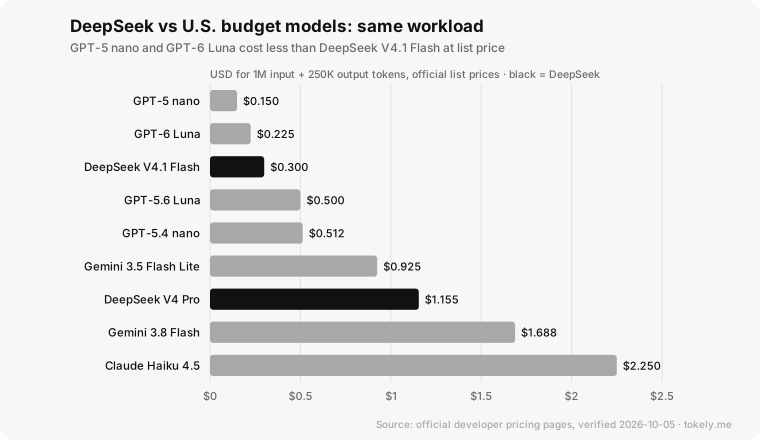
GPT-6 Luna also costs less than DeepSeek V4.1 Flash, pricing the same workload at $0.225 through rates of $0.10 per million input tokens and $0.50 per million output tokens. Mid-tier alternatives from the same providers command moderately higher rates, with GPT-5.6 Luna totaling $0.500 and GPT-5.4 nano landing at $0.512 for the same 1.25-million-token volume. Further up the price scale, Gemini 3.5 Flash Lite reaches $0.925, while DeepSeek V4 Pro costs $1.155 using its base rates of $0.66 per million input tokens and $1.98 per million output tokens.
Larger models cost more: Gemini 3.8 Flash comes to $1.688 for the same workload. Claude Haiku 4.5 rounds out the monitored group at $2.250 for the combined 1 million input and 250,000 output tokens.
Context caching shifts the economic balance when applications reuse extensive system prompts or reference documents. DeepSeek V4.1 Flash applies a 98 percent discount to cached inputs, dropping cached input rates to $0.003 per million tokens. OpenAI applies a 90 percent caching discount, resulting in cached input rates of $0.005 per million tokens for GPT-5 nano and $0.01 per million tokens for GPT-6 Luna.
When an engineering team caches 80 percent of input tokens, the net workload costs adjust noticeably across providers. Under an 80 percent cache scenario on that standard workload, GPT-5 nano costs $0.114, GPT-6 Luna costs $0.153, and DeepSeek V4.1 Flash costs $0.182. Price metrics do not measure model reasoning or task performance, so engineering teams should test prospective replacements against their specific application prompts before committing to a provider transition.
How do you switch models without rewriting code?
A single OpenAI-compatible API key on Tokely provides unified routing and billing across DeepSeek, OpenAI, Google, and Anthropic models. There is no new SDK, account or invoice per vendor. Migrating an existing integration from DeepSeek to another model requires only an update to the model ID string within your client configuration.
Test candidates on your own prompts before you switch production traffic. In the Playground you can run the same prompt on each candidate model first. You can review available target identifiers, pricing, and provider compatibility directly on the Tokely models index.
Sources
Regulatory documentation and reporting details can be found in Federal Register notice 2026-21447, alongside news coverage from CyberScoop and The Next Web, with API cost figures sourced from the Tokely pricing study Are AI APIs Getting Cheaper?.